

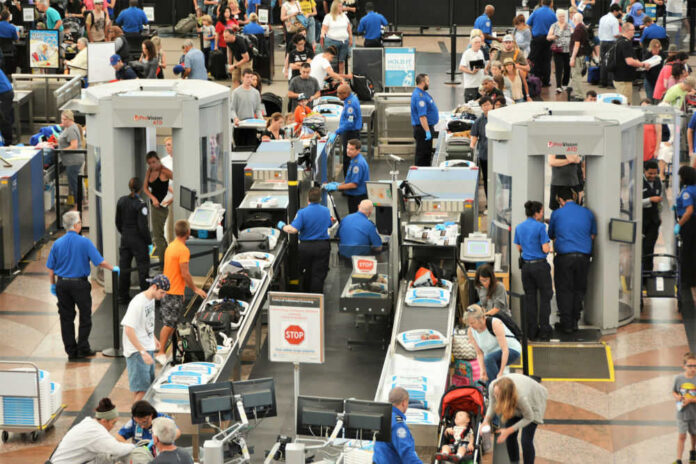
(LibertySociety.com) – After 36+ days of a DHS funding lapse, Americans are now watching immigration agents show up at airport checkpoints—because Washington still can’t pass a basic security budget.
Quick Take
- ICE agents began deploying to U.S. airports on March 23, 2026, as the partial DHS shutdown strained TSA staffing and checkpoint operations.
- President Trump blamed Senate Democrats, led by Chuck Schumer, for blocking DHS funding without ICE reforms tied to earlier incidents involving ICE agents.
- Schumer warned the move could worsen travel chaos, arguing ICE agents are not trained to do TSA screening work.
- Tom Homan said ICE would help relieve TSA by handling non-screening tasks, while Transportation Secretary Sean Duffy discussed broader airport support roles.
ICE Arrives at Airports as the Shutdown Enters Uncharted Territory
President Donald Trump’s administration began sending ICE agents to U.S. airports starting Monday, March 23, 2026, as the partial Department of Homeland Security shutdown dragged past five weeks. The immediate pressure point has been TSA, where unpaid staffing shortages and heavy sick callouts have fueled long security lines and missed flights at major hubs. Local reporting confirmed ICE arrivals at least at Atlanta, with broader deployments reported as the travel crunch intensified.
Tom Homan, tasked with leading the effort, framed the move as practical triage: ICE agents would free TSA officers from “non-significant roles” so screeners can focus on security functions that actually require TSA training. Transportation Secretary Sean Duffy also discussed wider support to stabilize airport operations. The precise scope still appears fluid across airports, and reporting has differed on how expansive the non-screening roles might become in practice.
How a Funding Fight Turned into a Travel Pileup
The shutdown began after DHS funding lapsed on February 14, 2026, pulling TSA, ICE, and other DHS components into the standoff. Reporting described more than 50,000 TSA frontline officers going without pay as disruptions mounted and morale cratered. Accounts also cited more than 400 TSA employees quitting, a sign the “temporary” pain of shutdown politics can become a real workforce problem. With spring travel surging, every missed shift has multiplied delays.
Senate Democrats argued their leverage point was ICE policy, demanding reforms and “guardrails” after two U.S. citizens were killed by ICE agents earlier in 2026. Republicans rejected partial measures and pushed for reopening DHS without concessions. A procedural attempt associated with Schumer to fund TSA separately failed after Senate Majority Leader John Thune blocked it, keeping the broader DHS impasse intact. The result has been a familiar Washington pattern: political theater on Capitol Hill, consequences at the checkpoint.
Security, Competence, and the Limits of “Emergency Fixes”
Schumer criticized the ICE deployment as a risky, chaotic response, arguing that untrained personnel shouldn’t be inserted into the delicate flow of airport security. Labor voices echoed concerns about training gaps and operational safety, warning that moving people around agencies does not instantly replace specialized screening expertise. Those warnings are not trivial: TSA work is process-heavy, compliance-driven, and designed to hold up under worst-case threats—not just clear long lines.
Homan’s counterpoint is narrower and easier to verify: if ICE is used for non-screening duties, that is not the same thing as asking ICE to run X-ray machines or conduct primary screening. Still, the public’s concern is understandable because “helping TSA” can mean different things depending on the airport, the supervisor, and the day’s staffing crisis. The administration’s challenge is to show clearly what ICE is doing—and what it is not doing—so travelers aren’t left guessing.
What This Means for Conservatives Watching the Bigger Picture
For conservatives frustrated with overspending and government dysfunction, the bitter irony is that Washington can burn billions through mismanagement yet can’t keep core homeland security functions funded without a standoff. For MAGA voters also weary of “forever wars” abroad, the domestic lesson is similar: when government leadership fails at basics, the public loses trust fast. This episode is less about ideology than competence—Congress and the executive branch both face pressure to restore normal operations without eroding civil liberties.
It's Happening: ICE Shows Up at Multiple Airports As Schumer Shutdown Travel Chaos Intensifieshttps://t.co/lZR5w80dJP
— RedState (@RedState) March 23, 2026
The immediate next test is whether lawmakers end the shutdown with a clean funding deal or extend the fight by tying immigration enforcement reforms to paychecks and airport operations. The public record so far supports two conclusions: TSA staffing strain is real, and the ICE deployment is a stopgap, not a durable fix. Until DHS funding is restored, travelers and frontline workers remain stuck in a political crossfire, and airport security becomes another bargaining chip.
Sources:
Schumer gambit fails as DHS shutdown hits 36 days and airport lines grow
Senate fails again to fund DHS as shutdown impacts airports nationwide
Schumer knocks Trump plan to send ICE to airports as ‘asking for trouble’
ICE at airports: Homan, Duffy, and the Trump administration response
Trump says ICE agents will be sent to US airports starting Monday with Homan leading
Copyright 2026, LibertySociety.com