

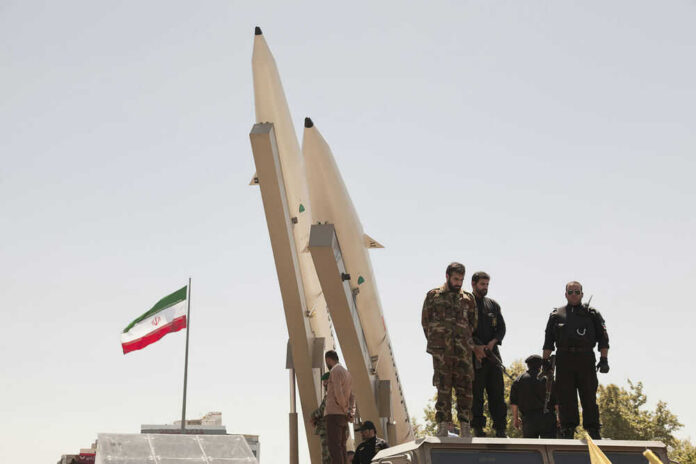
(LibertySociety.com) – A massive intelligence failure has left the United States fighting a prolonged war with Iran after undercounting Tehran’s ballistic missile arsenal by more than 1,000 weapons, miscalculating their range by 50%, and completely missing vast underground storage complexes that have kept Iranian strike capabilities alive despite weeks of intensive bombing.
Story Highlights
- U.S. intelligence estimated Iran possessed roughly 3,000 ballistic missiles in 2022, but the actual arsenal exceeded 4,000 weapons
- Iran’s missile range proved 50% greater than assessed, with launches reaching toward Diego Garcia demonstrating unexpected capability
- Underground “cities” housing missiles went undetected, allowing Iran to preserve half its launchers after five weeks of U.S. and Israeli strikes
- Pentagon officials deny reports while leaked intelligence assessments contradict administration claims of successful arsenal destruction
Intelligence Estimates Missed the Mark by Thousands
Gen. Kenneth McKenzie testified before Congress in 2022 that Iran maintained approximately 3,000 ballistic missiles, an estimate that became the foundation for U.S. military planning. Intelligence analysts now acknowledge the actual stockpile exceeded this figure by more than 1,000 weapons. By June 2025, Iran was producing at least 50 missiles monthly, a production rate that U.S. assessments failed to fully account for when calculating Tehran’s growing capabilities. The undercount mirrors intelligence failures preceding the 2003 Iraq invasion, raising questions about systemic problems within America’s intelligence community that leave policymakers operating on flawed assumptions.
Range Calculations Proved Dangerously Inaccurate
Iranian missiles demonstrated ranges approximately 50% greater than intelligence estimates predicted, with launches targeting areas near Diego Garcia in the Indian Ocean far exceeding the declared maximum range of 1,864 miles. The Islamic Revolutionary Guard Corps announced range extensions beyond previous self-imposed limits in 2018, but U.S. analysts appear to have dismissed or underweighted these claims. This miscalculation has direct implications for American military installations and allies throughout the Middle East and beyond, as assets previously considered outside Iran’s reach now fall within striking distance. The range revelation fundamentally alters strategic calculations about deterrence and defense positioning across the region.
Underground Complexes Escaped Detection
Perhaps the most significant intelligence gap involves extensive underground storage facilities that analysts describe as “cities” capable of protecting missiles from aerial bombardment. These subterranean complexes, built with assistance from North Korean engineering expertise developed since Iran’s 1979 Revolution, have proven critical to Tehran’s ability to sustain operations. After more than five weeks of intensive U.S. and Israeli strikes, intelligence assessments indicate approximately 50% of Iran’s missile launchers remain intact and accessible through these underground networks. The facilities also house thousands of drones and most cruise missiles, creating layered threats that complicate American military planning and extend potential conflict timelines well beyond initial projections.
Official Claims Contradicted by Leaked Assessments
President Trump and Pentagon officials have publicly claimed significant success in destroying Iran’s missile capabilities, with early Israeli Defense Forces estimates suggesting 75% of launchers were eliminated during the first week of operations. However, leaked intelligence assessments paint a starkly different picture, with U.S. analysts confirming only one-third of the arsenal destroyed after multiple weeks of strikes. Pentagon spokesman Sean Parnell dismissed reports as “completely wrong” and insisted operations remain “far ahead of schedule,” yet sources speaking to CNN acknowledged the campaign “won’t be done in two weeks” given Iran’s remaining capabilities. This disconnect between public messaging and classified assessments raises concerns about transparency and whether the American people are receiving accurate information about a conflict that shows no signs of quick resolution.
Operational Reality Forces Strategy Reassessment
Iran has launched more than 500 missiles at Israel since the conflict began, with the IDF reporting a 92% interception rate that nonetheless represents significant operational strain on defensive systems. Israel claims to have destroyed 200 launchers and rendered 80 additional units inoperable through tunnel strikes, yet the preserved underground arsenal ensures Iran retains substantial strike capacity. The ongoing threat to the Strait of Hormuz from Iranian cruise missiles and drones creates economic pressure through potential shipping disruptions. Defense analysts note the intelligence failures regarding missile quantities, ranges, and storage infrastructure fundamentally undermine U.S. strike modeling and force a reassessment of how quickly military operations can neutralize determined adversaries with hardened infrastructure. This reality check comes at a steep cost measured in extended conflict duration and accumulated risks to American personnel and regional allies.
Sources:
US intelligence said to assess around half of Iran’s missile launchers still intact
The biggest intelligence failure of the Iran war
Half of Iran’s missile launchers still intact despite strikes
Trump claims on Iran missiles contradicted by intelligence assessments
Copyright 2026, LibertySociety.com