

(LibertySociety.com) – Iran’s de facto shutdown of the Strait of Hormuz has turned a regional war into a direct, daily squeeze on working families’ fuel bills—and it’s not clear who can force the waterway back open.
Story Snapshot
- Commercial traffic through the Strait of Hormuz has plunged amid attacks, warnings, and soaring war-risk insurance, making the chokepoint “technically open” but practically unusable for many shippers.
- The disruption follows the February 2026 U.S.-Israel strikes on Iran that killed Supreme Leader Ali Khamenei and triggered Iranian retaliation across the Gulf.
- President Trump has issued deadlines and public threats demanding resumed shipping, while Iran signals a “new order” that could include tolls and selective passage.
- Analysts warn that a second choke point—Bab el-Mandeb at the Red Sea—would multiply the economic shock, though current evidence for a 2026 Houthi shutdown remains speculative.
Hormuz “Open” on Paper, Closed in Practice
Iran’s Islamic Revolutionary Guard Corps has leveraged geography, drones, missiles, and harassment tactics to make transits through the Strait of Hormuz intolerably risky. Multiple reports describe shipping warnings, vessel damage, and periods when ships reduced tracking broadcasts, while insurers pulled or repriced coverage and crews hesitated to sail. The result has been a sharp drop in traffic rather than a neat legal blockade—yet for energy markets and supply chains, that distinction hardly matters.
The crisis escalated after the Feb. 28, 2026 U.S.-Israel strikes in Iran and Iran’s subsequent retaliation against regional targets and maritime commerce. Timeline reporting describes a progression from initial disruptions to more formalized restrictions, including bans on U.S., Israeli, and allied-linked shipping. Even where selective passages occur, the underlying threat environment can still deter carriers—especially when one successful strike can strand a ship, spike insurance rates, and freeze scheduling across entire fleets.
Trump’s Deadline Diplomacy Meets Iran’s “New Order” Messaging
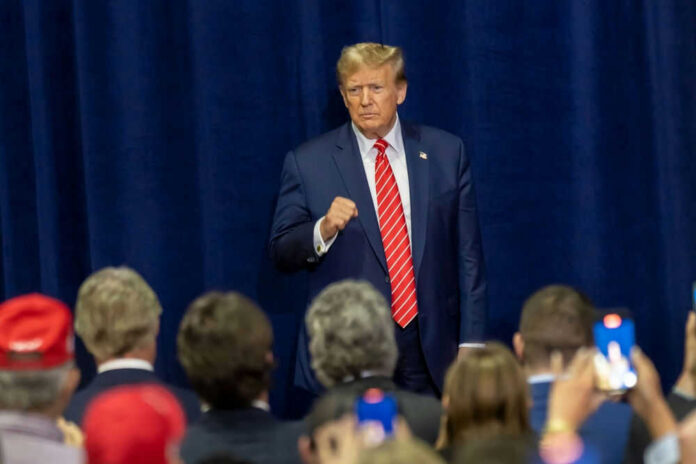
President Trump’s administration has framed reopening the strait as a strategic necessity, issuing deadlines and high-profile public warnings aimed at restoring predictable commerce. Iranian officials, however, have responded with defiance, portraying U.S. pressure as escalation and signaling that the Gulf will not simply revert to pre-war norms. Some reporting suggests Iran has floated tolls or controlled access, allowing certain non-Western or non-aligned vessels while blocking others—an approach that turns a global artery into a bargaining chip.
This is where frustration with “elite” decision-making hardens across party lines. When Washington’s choices and Tehran’s counter-moves collide, ordinary citizens don’t get a vote—but they do get the bill at the gas pump and the grocery store. Conservatives who already distrust globalist dependency see the vulnerability clearly: concentrated chokepoints, fragile supply chains, and energy policy debates that were once theoretical become painfully real when tankers stop moving.
Why Energy and Shipping Disruptions Hit Main Street Fast
The Strait of Hormuz carries roughly a fifth of global oil and significant liquefied natural gas flows, so prolonged disruption quickly feeds into higher prices, rationing discussions, and knock-on inflation. Reporting and expert analysis describe fuel rationing pressures emerging in parts of Europe and Asia and warn that prolonged constraints can ripple into manufacturing inputs, food logistics, and household heating costs. For the U.S., domestic production can buffer impacts, but global pricing still transmits pain.
Shipping risk compounds the energy shock. When war-risk premiums surge or coverage is withdrawn, the cost of every voyage rises—even for routes that remain technically feasible. Some vessels may idle, reroute, or wait for naval escorts, while ports and refiners scramble for alternative cargoes. Analysts have also pointed to limited substitute routes, including pipelines and overland options, but those alternatives rarely replace Hormuz volumes quickly, especially under wartime conditions.
The Red Sea “Depression” Scenario: Plausible Mechanics, Limited 2026 Proof
Warnings about a second chokepoint crisis—Bab el-Mandeb leading into the Red Sea—follow a straightforward logic: if Hormuz constricts Gulf energy exports while Red Sea routes face major disruption, global shipping times and fuel availability could deteriorate sharply. That said, the research here shows the “Houthis shut down Bab el-Mandeb” claim is largely hypothetical for 2026, not a documented present reality on the level of Hormuz’s effective closure. The mechanism is plausible; the evidence is incomplete.
For policymakers, the immediate challenge is restoring maritime predictability without stumbling into open-ended escalation. For voters, the bigger lesson is structural: modern life depends on narrow global choke points that can be disrupted by regimes and militias with relatively cheap weapons. That reality collides with years of arguments over energy independence, industrial capacity, and whether America should accept higher costs at home in exchange for climate-driven constraints that may increase vulnerability abroad.
Sources:
https://www.jpost.com/middle-east/iran-news/article-892180
https://time.com/article/2026/04/05/strait-of-hormuz-fuel-rationing-oil/
https://jewishinsider.com/2026/04/strait-of-hormuz-closure-alternative-shipping-lanes-experts/
https://en.wikipedia.org/wiki/2026_Strait_of_Hormuz_crisis
https://www.csis.org/analysis/no-one-not-even-beijing-getting-through-strait-hormuz
https://www.dallasfed.org/research/economics/2026/0320
Copyright 2026, LibertySociety.com