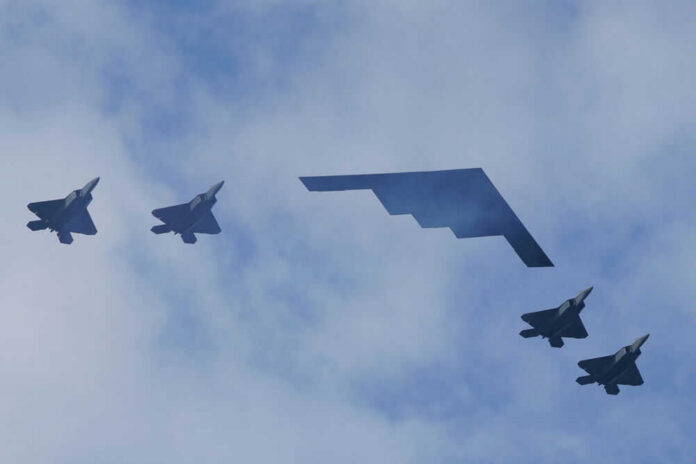
(LibertySociety.com) – America’s air-superiority edge still hinges on a stealth fighter Washington stopped building years ago.
Quick Take
- The “Stealth Surprise” framing reflects the F-22’s defining advantage: low observability paired with speed, agility, and advanced sensors.
- The F-22 grew out of the Air Force’s Advanced Tactical Fighter program, with roots in the 1980s and operational service beginning in 2005.
- Production ended at 195 aircraft after cost pressures and shifting priorities, leaving a limited fleet for today’s high-end threats.
- As of 2026, the Air Force is extending the platform through upgrades, including signature-reduction work and modernization to bridge to NGAD.
Why “Stealth” Still Defines the F-22’s Real Deterrence Value
The F-22 Raptor’s reputation is not built on a slogan—it is built on low observability designed to delay detection and give U.S. pilots first-look, first-shot advantages in contested airspace. Shaping choices such as aligned edges, internal weapons bays, and specialized inlets reduce radar signature while preserving performance. Aviation analysis often distills this into a single word—“stealth”—because surprise and survivability are the foundation of air dominance.
The Air Force designed the jet to avoid the tradeoffs older stealth platforms faced. The F-117 demonstrated stealth’s battlefield impact, but it did not offer a full air-to-air dogfighting package. The F-22, by contrast, pairs stealth with supercruise and extreme maneuverability, including thrust-vectoring, to dominate both beyond-visual-range engagements and close-in fights. That combination explains why the aircraft remains a benchmark even as rivals pursue their own stealth designs.
How the Advanced Tactical Fighter Program Produced a Fifth-Gen Standard
The F-22 traces back to the Advanced Tactical Fighter program launched in the early 1980s, when U.S. planners sought a next-generation replacement for the F-15 under the shadow of Soviet capabilities. The YF-22 prototype won selection in 1991 over the YF-23, with analyses commonly citing agility advantages as a key discriminator. The aircraft first flew in 1997, entered production in 2001, and reached operational service in 2005.
That timeline matters because it shows how long the United States has relied on this specific airframe for the “kick the door down” air-superiority mission. The design blended stealth with sensors and avionics to help pilots detect threats, manage the battlespace, and strike without broadcasting their presence. Researchers also caution that dramatic claims—like tiny radar cross-section comparisons—can be context-dependent, varying by aspect angle and radar type, especially against low-frequency surveillance systems.
What Congress’ Production Cap Meant for the Fleet America Has Today
The most consequential policy outcome for the F-22 was not aerodynamic—it was arithmetic. Production ultimately stopped at 195 aircraft, a decision shaped by cost debates and post-Cold War budget pressures, later reinforced as priorities shifted toward the F-35 for broader multi-role capacity. The result is a small, prized fleet that cannot be easily expanded. For taxpayers, that constraint raises the stakes on sustainment, readiness, and upgrade choices.
By 2026 reporting, the Air Force has about 187 combat-coded aircraft, and official materials have highlighted stealth mission-capable rates in the broad range of roughly 62% to 70%. Even supporters acknowledge a reality that should be familiar to anyone skeptical of government procurement: cutting-edge capability tends to demand complex maintenance. The practical question is whether modernization can keep enough Raptors ready for high-end deterrence while the next-generation air dominance effort matures.
2026 Upgrade Talk: Extending the Raptor to Bridge the NGAD Gap
Current reporting and commentary describe continued work to extend the F-22 into the 2030s, with modernization efforts aimed at keeping it viable against evolving air defenses and advanced fighters. Updates discussed across sources include signature-reduction initiatives such as newer surface treatments tested since 2021, and concepts like external stealthy tanks or pylons to increase range without abandoning the low-observable mission. Some upgrade discussion—especially from video analysis—should be treated as preliminary.
Stealth Surprise: The F-22 Super Raptor Summed Up in 1 Wordhttps://t.co/0j00ADM6NO
— 19FortyFive (@19_forty_five) March 5, 2026
For a conservative audience tired of waste and strategic drift, the lesson is straightforward: America’s decisive advantages come from disciplined priorities, not fashionable slogans. The F-22’s core advantage—stealth paired with performance—remains central because it protects pilots and preserves deterrence. With a capped fleet and real-world readiness constraints, policy decisions now revolve around modernization and sustainment choices that keep the Raptor credible until NGAD arrives in meaningful numbers.
Sources:
https://en.wikipedia.org/wiki/Lockheed_Martin_F-22_Raptor
https://www.lockheedmartin.com/en-us/news/features/history/f-22.html
https://illumin.usc.edu/stealth-characteristics-of-the-f-22-raptor/
https://nationalsecurityjournal.org/how-the-f-22-raptor-stealth-fighter-was-born/
https://www.af.mil/About-Us/Fact-Sheets/Display/Article/104506/f-22-raptor/
https://www.airandspaceforces.com/weapons-platforms/f-22/
Copyright 2026, LibertySociety.com