A detective shot in a remote California desert, a suspect dead, and still almost no answers about how our system let it get this far.
Story Snapshot
- A San Bernardino County sheriff’s detective was shot during an investigation in the Antelope Valley desert and airlifted to a hospital in stable condition.
- The suspected gunman died at the scene, but officials have not explained how he was killed or released his identity.
- Homicide investigators from the Los Angeles County Sheriff’s Department are running the crime scene, while details of the operation and motive remain unclear.
- The ambush echoes other recent attacks on deputies near Palmdale, raising fears that law enforcement and the public are both left exposed by a failing system.
Detective Ambushed In Remote Desert Investigation
On Wednesday afternoon, a San Bernardino County sheriff’s detective was shot while working an investigation in the high desert near Palmdale. The gunfire erupted around 3:15 p.m. near the intersection of East Avenue R and 130th Street in Littlerock, a sparsely populated area east of the city. Officials said the detective was hit in the lower rib area and rushed by helicopter to Antelope Valley Hospital, where he was reported in stable condition after emergency care.
https://www.youtube.com/watch?v=MxIJGPVTQzM
Authorities have not released the detective’s name, rank beyond “detective,” or any detailed medical update beyond “stable.” Reporters at the briefing were told the detective was conducting an investigation in Antelope Valley when he was ambushed, but they were given no clear description of the case he was working. One outlet, citing deputies at the scene, said officers were serving a search warrant at a nearby home when the shooting started, suggesting a planned operation that turned into a gun battle.
Suspect Dead, Key Details Still Hidden From Public
Law enforcement leaders confirmed that the person believed to have shot the detective was pronounced dead in the desert after the exchange of gunfire. They did not say whether deputies shot the suspect, whether the suspect turned the gun on himself, or how many rounds were fired in total. The suspect’s identity, age, and any criminal history also remain withheld, leaving people in the area with little sense of who sparked the violence or why.
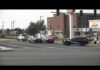
Aerial images from the scene showed multiple law enforcement vehicles, a ballistic vest lying on the ground, and scattered buildings and trailers in the background. Witnesses described a heavy response by Los Angeles County sheriff’s deputies converging on the area, while San Bernardino County units locked down access roads and searched the surrounding desert. Officials later said one suspect was dead and that they believed a second person might have been involved, but they did not clarify whether that individual had been found, detained, or cleared.
Two Sheriff’s Departments, One Sparse Story
Homicide detectives from the Los Angeles County Sheriff’s Department are leading the crime scene investigation, working alongside the San Bernardino County Sheriff’s Department. This kind of cross-county response is common in the Antelope Valley, where county lines cut across rural towns but crime and policing do not stop at the border. Yet the split role can also slow clear public answers, because each agency waits to release details until the joint investigation is complete and lawyers sign off.
August 5, 2026
The Los Angeles County Sheriff’s Department is the investigating agency for the shooting involving the San Bernardino County Sheriff’s detective.
All media inquiries should be directed to them. pic.twitter.com/ROApyblIQx
— San Bernardino County Sheriff (@sbcountysheriff) August 5, 2026
The brief public statements so far leave major gaps. Officials have not described the original reason for the warrant or investigation, the number of officers present, or the exact order of events leading up to the shooting. News outlets all repeat the same short facts: a detective shot around 3:15 p.m., a suspect dead at the scene, a rural location, and a stable hospital condition. With no press release, case number, or court warrant on the record yet, people are left to piece together the story from fragments.
Pattern Of Deputy Ambushes Fuels Public Anger
For residents of Palmdale and the Antelope Valley, this latest shooting does not feel like an isolated event. In 2023, Los Angeles County Sheriff’s Deputy Ryan Clinkunbroomer was ambushed and killed while waiting at a red light outside the Palmdale station, shot in the head as he sat in his patrol car. His parents now plan to sue the county, arguing that extreme overtime and understaffing left him worn down and more vulnerable to attack in a community already on edge.
That case followed other ambush-style attacks on deputies across Los Angeles County, including a Compton shooting where a gunman walked up to a parked squad car and opened fire without warning. These incidents have fed a growing belief among both conservatives and liberals that the system is failing everyone: officers who feel outnumbered and overworked, and residents who see violence spike while elected leaders focus on talking points instead of basic safety. Each new desert shootout or patrol-car ambush adds fuel to that anger.
Broken Trust, Thin Transparency, And A Shared Fear
For many conservatives, this desert ambush fits a familiar story line. They see a justice system that talks about reform and “equity” while officers face rising threats and criminals appear to face few real consequences. They point to overtime, understaffing, and past ambushes as proof that government prefers slogans over serious investments in public safety and mental health care. To them, another detective bleeding in the sand shows that the so-called elites are not the ones taking the bullets.
Many liberals look at the same events and see a different but related failure. They worry about guns in the hands of unstable people, deep economic gaps in high-desert communities, and decades of policy choices that left places like Littlerock poor, angry, and on edge. They question why basic information about police shootings is so hard to get, and why watchdog agencies and lawmakers rarely force quick transparency when a person dies in state custody or a deputy is gunned down in broad daylight.
Why This Desert Shooting Matters Beyond One Case
When a detective is shot in a remote California desert and the suspect dies, people deserve more than a few vague lines about a “still ongoing” investigation. Without clear facts, residents start filling in the blanks with rumor, past news clips, and their own fears. Was this tied to gangs? Drugs? Mental illness? A bad warrant? A mistake? None of those questions can be answered yet, and that silence fuels the sense that the public is an afterthought in its own democracy.
The bigger concern is simple: both left and right increasingly agree that everyday Americans are not the priority. Deputies get ambushed at red lights. Detectives are shot in the desert. Suspects die with no explanation. Families mourn, communities harden, and the official record stays thin. Until leaders start treating these shootings as a call to fix deeper problems — from staffing and training to mental health, gun policy, and real transparency — the Antelope Valley will stay a symbol of a country drifting away from its promise of safety and justice for all.
Sources:
nypost.com, abc7.com, nbclosangeles.com, youtube.com, cbsnews.com, laist.com, lasd.org, dailynews.com
© libertysociety.com 2026. All rights reserved.