

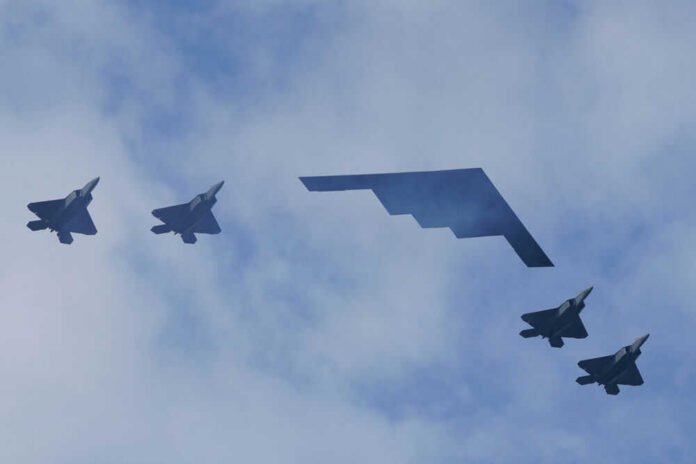
(LibertySociety.com) – The Air Force’s rush to field the F-47 NGAD fighter by 2028 overlooks a critical reality: not a single pilot has ever flown this sixth-generation aircraft, raising serious questions about operational readiness while taxpayers face costs triple that of the already expensive F-35.
Story Snapshot
- Boeing’s F-47 NGAD fighter targets 2028 first flight with zero pilot training programs announced, creating unprecedented risk in test flight phase
- Operational availability now slips to mid-2030s despite Air Force claims of being “on track,” forcing expensive F-22 life extensions and continued F-35 purchases
- Unit costs exceed three times the F-35 price tag while Rep. Rob Wittman warns of capability gaps against China and Russia through the next decade
- Program relies on classified X-plane data from 2010s prototypes, but no public evidence shows pilots prepared for revolutionary sixth-generation systems
Air Force Promises 2028 Flight With No Training Pipeline
Gen. Dale White reaffirmed at the February 2026 AFA Warfare Symposium that the F-47 remains on schedule for its 2028 maiden flight, with Boeing ramping up personnel and the first airframe under construction. Yet nowhere in official statements or congressional testimony does the Air Force address how pilots will transition to a platform featuring revolutionary stealth, adaptive engines, and collaborative combat aircraft integration. This silence stands in stark contrast to historical fighter programs, where test pilots accumulated incremental experience on predecessor aircraft. The F-22 Raptor, for example, built on decades of F-15 operational knowledge before its 1997 production flight, six years after Lockheed won the contract in 1991.
Mid-2030s Reality Contradicts Pentagon Optimism
House Armed Services subcommittee chair Rep. Rob Wittman delivered a sobering assessment on March 17, 2026, at the McAleese Conference: operational availability will not arrive until the mid-2030s, creating a dangerous capability gap as adversaries advance their own sixth-generation programs. This timeline directly contradicts the Air Force’s public confidence, exposing a distinction between achieving a test flight milestone and fielding combat-ready squadrons. Wittman emphasized the necessity of extending F-22 service life and sustaining F-35 purchases as a “bridge” through this decade-long delay. For families watching gas prices spike and federal spending balloon under this administration’s Iran entanglement, the prospect of pouring billions into three overlapping fighter fleets raises legitimate fiscal concerns.
Taxpayer Costs Mount With No Clear Accountability
The F-47 program carries a unit cost exceeding three times the F-35’s price, with at least 185 aircraft planned for procurement. Then-Secretary Frank Kendall paused the program in May 2024 specifically due to these ballooning expenses, forcing an internal study that reluctantly affirmed its necessity by early 2025. Boeing received the development contract in March 2025, banking on its ability to deliver despite recent credibility issues with the KC-46 tanker and commercial aviation setbacks. Meanwhile, FY2026 allocated $4.4 billion for F-35 sustainment alone, compounding the financial burden on Americans already struggling with inflation from years of government overspending and now war-driven energy costs.
Classified Programs Leave Pilots and Public in the Dark
The Air Force justifies its aggressive timeline by citing X-plane prototypes flown in the 2010s that de-risked sixth-generation technologies, including stealth advancements and Next Generation Adaptive Propulsion engines. However, these experimental flights remain classified, with no public disclosure of how many test pilots participated, what lessons were learned, or how that data translates to operational F-47 training. Engine delays in the NGAP program further complicate readiness, though officials declined to specify whether initial F-47 variants will use these advanced powerplants. This opacity prevents meaningful oversight at a time when Congress and constituents deserve answers about whether the Pentagon can responsibly field a fighter with specifications including greater than 1,000 nautical mile combat radius and speeds exceeding Mach 2—capabilities designed for Pacific air dominance against China.
The F-47 NGAD Fighter Has 1 Problem Nobody Is Talking About: There’s No Pilot Who Has Ever Flown Ithttps://t.co/2C4hPe9x5U
— 19FortyFive (@19_forty_five) March 24, 2026
The disconnect between Air Force assurances and congressional warnings reflects a broader pattern seen in defense procurement: optimistic projections masking operational realities. Gen. White’s praise of Boeing’s progress ignores the human element—pilots who must master unprecedented systems without the safety net of prior platform experience. As the Trump administration navigates an unpopular war in Iran and faces divided MAGA support over foreign entanglements, the F-47’s trajectory symbolizes the costly consequences of prioritizing hardware timelines over readiness. Taxpayers funding this program deserve transparency about whether the 2028 flight represents genuine capability or merely a public relations milestone, especially when operational availability lags a full decade behind and adversaries continue modernizing their forces.
Sources:
F-47 Program On Track for 2028 Flight – Air & Space Forces Magazine
Sorry F-22 and F-35: The New F-47 NGAD Stealth Fighter Is Coming to the U.S. Air Force – 19FortyFive
Possible Change To F-47 6th Generation Fighter’s Designation Raised By Trump – The War Zone
F-47 Air Force Mid-2030s Top Lawmaker – Air & Space Forces Magazine
First F-47 Now Being Built, Will Fly in 2028: US Air Force Chief – Defense News
Next Gen Air Dominance And Surprise New Air Force Leadership: 2025 Review – Breaking Defense
Copyright 2026, LibertySociety.com