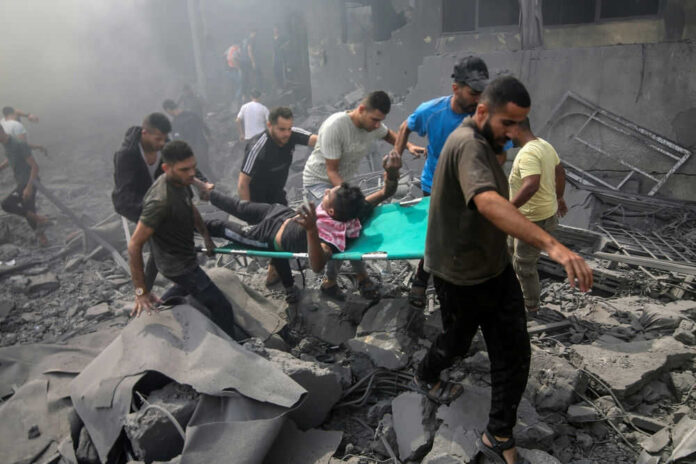
(LibertySociety.com) – The ongoing debate over whether the Gaza conflict constitutes genocide threatens to undermine Israel’s international standing and provoke further geopolitical tensions.
Story Highlights
- The International Court of Justice has found a “plausible risk” of genocide in Gaza.
- Israel faces accusations of targeting civilians, though it claims self-defense against Hamas.
- UN experts highlight potential genocidal acts, intensifying global scrutiny.
- Intense debate persists over the legal definitions and evidence of genocide.
Legal Definitions and International Concerns
The International Court of Justice (ICJ) has issued provisional measures acknowledging a “plausible risk” of genocide in Gaza, a move that has amplified global attention. The court’s decision highlights the severity of the allegations against Israel, which, according to some UN experts, may have engaged in actions that align with genocidal acts. The ongoing military operations have led to widespread destruction and a humanitarian crisis, a scenario that challenges Israel’s narrative of targeting Hamas rather than the Palestinian population.
Israel’s stance remains firm, asserting that its military actions are a necessary response to the threats posed by Hamas. The Israeli government argues that the operations are compliant with international law and are aimed at minimizing civilian casualties. However, the scale of destruction and the siege conditions have drawn severe criticism from humanitarian organizations, which report worsening malnutrition and inadequate medical care in Gaza. These developments have sparked a global discourse on the legal parameters of genocide and the responsibilities of occupying powers.
Arguments For and Against Genocide Classification
Proponents of the genocide classification point to the extensive civilian casualties and the systematic destruction of infrastructure as evidence of intent to destroy a group in whole or in part. Médecins Sans Frontières and other NGOs have documented patterns of attacks that suggest a deliberate strategy to inflict harm on civilians. They argue that the blockade and military tactics employed in Gaza meet the criteria outlined in the Genocide Convention, specifically the deliberate infliction of conditions calculated to bring about physical destruction.
Conversely, Israel and its allies maintain that the military campaign is focused on dismantling Hamas’s capabilities, not targeting Palestinians as an ethnic group. They argue that the use of warnings and evacuation orders exemplifies efforts to prevent civilian harm. Some legal scholars caution against prematurely labeling the conflict as genocide, emphasizing the importance of preserving the term’s legal precision and focusing on other potential violations such as war crimes or crimes against humanity.
Ongoing Humanitarian and Legal Challenges
The humanitarian situation in Gaza remains dire, with reports of mass casualties and severe infrastructure damage. Over 70,000 Palestinians have been killed, and the majority of the population has been displaced, living in precarious conditions. Health services are collapsing due to attacks on medical facilities and critical shortages of supplies. The ICJ’s directive for Israel to prevent genocidal acts and ensure humanitarian aid access underscores the international community’s concern over the conflict’s trajectory.
The ongoing conflict has significant implications for regional stability and international law. The ICJ’s involvement may set precedents for how sieges and large-scale bombardments are evaluated under genocide law. Meanwhile, the humanitarian toll continues to mount, with aid agencies struggling to address the escalating needs amid restrictions. As the situation evolves, the global community remains divided on the appropriate response and the path to peace.
Sources:
Timeline Bearing Witness to Genocide in Gaza
Israel-Hamas War: Timeline of Events
Copyright 2026, LibertySociety.com