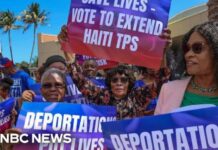

The Supreme Court has just handed President Trump sweeping new power over immigration while sharply cutting back court oversight, and the battle over what “rights” mean is now front and center for every American.[1][5]
Story Snapshot
- The Court upheld Trump’s power to end Temporary Protected Status for hundreds of thousands of migrants with almost no judicial review.[1]
- In a second case, the Court backed strict limits on asylum at the border, saying migrants turned away before entry cannot seek protection.[2][3]
- These rulings fit a long trend of the Court narrowing court review in immigration, leaving more power in government hands.[5][6]
- Critics say this makes rights “meaningless,” while many conservatives see it as needed border control and respect for the rule of law.[1][2]
Supreme Court Hands Trump Major Wins on Immigration Power
On June 25, 2026, the Supreme Court issued two 6-3 rulings that gave the Trump administration broad control over immigration programs with little room for court challenges.[1][2] In the first case, the Court said the administration can end Temporary Protected Status for large groups of migrants, including Haitians and Syrians, and that federal courts have no authority to review those decisions.[1] This opened the door to removing legal status from hundreds of thousands of people who had lived and worked in the United States for years.[1]
In the second ruling, the Court backed a strict border policy known as “metering,” which limits how many people can seek asylum at official crossings each day.[2][3] The justices agreed with the Trump team that migrants turned away before they step onto United States soil have no right under the Immigration and Nationality Act to apply for asylum.[3] Justice Samuel Alito compared them to a guest who has not entered a house until he actually walks through the door, stressing that the law covers those already inside the country, not people waiting outside.[3]
How These Decisions Fit a Long Trend of Less Judicial Review
Legal experts say these new immigration decisions are part of a decades-long pattern of Congress and the Court cutting back what federal judges can review in immigration cases.[5][6] After laws like the Illegal Immigration Reform and Immigrant Responsibility Act and the REAL ID Act, many challenges to removal orders were pushed into appeals courts only, and district courts lost most of their power to review deportation decisions.[11] More recent cases, such as Patel v. Garland, further limited courts from correcting factual mistakes by immigration agencies, even when those mistakes lead to someone being removed from the country.[5][6]
Advocates note that in key rulings like Department of Homeland Security v. Thuraissigiam, the Supreme Court allowed very narrow review for migrants in fast-track removal, giving the government broad freedom to deny asylum without much court oversight.[7] At the same time, the Court has sometimes protected narrow legal review, such as allowing appeals courts to check whether agencies applied the law correctly in certain torture protection cases.[7][12] Taken together, the record shows a Court that often says judges can review pure legal questions but keeps them away from big policy choices and many front-line factual calls in immigration matters.[5][7]
Debate: Strong Borders and Limited Courts vs. Fears of “Meaningless Rights”
Supporters of the Trump administration see the June 25 rulings as long overdue steps to regain control of the border and end programs they view as abused or stretched beyond their original purpose.[1][2] They argue that the Constitution gives elected leaders, not unelected judges, primary authority over who enters and stays in the United States, and that past courts allowed too many lawsuits that blocked clear policies.[9][13] For many conservatives, limiting judicial review of discretionary immigration decisions is part of restoring common sense and stopping activist courts from importing left-wing agendas into border policy.[5][6]
Critics, including former immigration officials and civil rights advocates, warn that when courts cannot review major immigration decisions, rights on paper can become impossible to enforce.[5] Andrea Flores, a former Homeland Security official under Democrat administrations, called the Temporary Protected Status ruling “the biggest delegalization of immigrants we’ve seen in modern history,” pointing to the large number of people who could lose status at once.[4] Groups worried about due process say these decisions, added to earlier cases that bar review of visa denials and many asylum findings, risk creating an America where government mistakes and bias go unchecked and basic protections become hollow promises.[5][9]
What This Means for Everyday Americans and Constitutional Values
For most readers, these cases are not just about migrants at the border; they raise hard questions about how much power the federal government should have without court checks.[5][7] The Supreme Court has repeated that immigration is a special area where political branches have wide control, and courts should rarely question the wisdom, justice, or fairness of policies.[13] That approach can appeal to conservatives who want strong borders and a clear chain of command, but it can also trouble those who worry about government overreach and the erosion of basic due process protections that stand at the heart of the Constitution.[13]
Going forward, Congress still has the power to adjust how much court review exists for immigration decisions, but recent laws have mostly cut back that review rather than expand it.[11] For Trump supporters, the latest rulings may feel like victories for sovereignty, security, and the rule of law. For others, they feed a growing fear that the Supreme Court is turning rights into privileges that depend on who you are and whether the government chooses to let a judge hear your case.[5][9] The clash between those views will shape coming debates over immigration, courts, and the meaning of liberty for years to come.
Sources:
[1] Web – The Supreme Court’s Era of Meaningless Rights
[2] Web – Supreme Court allows Trump to end protected status for Haitian and …
[3] Web – On June 25, 2026, the US Supreme Court ruled 6-3 that the Trump …
[4] Web – US Supreme Court paves way for government to block asylum …
[5] Web – Supreme Court says U.S. can turn away asylum seekers at the border
[6] YouTube – Supreme Court rules Haitians, Syrians with TPS can be deported
[7] Web – The Supreme Court has ruled 6-3 to allow the ending of Temporary …
[9] Web – Evaluating the Supreme Court: Harvard Law faculty weigh in on …
[11] Web – How Courts Do — and Don’t — Respond to Statutory Overrides
[12] Web – Can Congress overturn Supreme Court rulings? | CU Boulder Today
[13] Web – The Effect of Supreme Court Rulings and Stare Decisis – FindLaw
© libertysociety.com 2026. All rights reserved.