

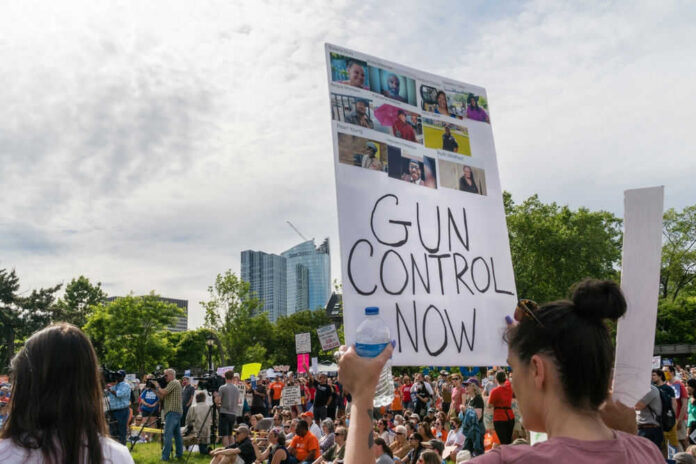
(LibertySociety.com) – Hawaii’s “default no-carry” rule turns ordinary, law-abiding self-defense into a jailable offense—unless you get explicit permission first.
Story Snapshot
- Hawaii’s post-Bruen law presumes guns are banned on private property open to the public unless owners give “express authorization,” making carry permits far less useful.
- Violations can be prosecuted as misdemeanors punishable by up to one year in jail, even for licensed concealed-carry holders.
- The U.S. Supreme Court heard arguments on January 20, 2026; conservative justices signaled skepticism while the Trump DOJ backed the challengers.
- Hawaii lawmakers are simultaneously pushing additional firearm restrictions in the 2026 session, including proposals affecting certain firearms and penalties.
How Hawaii’s “Express Permission” Rule Rewrites Public Carry
Hawaii’s statute, signed in 2023 after the Supreme Court’s Bruen decision, makes carrying on private property open to the public illegal by default unless the owner provides “express authorization” through a sign or direct permission. That includes everyday places where self-defense questions actually arise—restaurants, stores, and similar public-facing businesses. A licensed carrier who gets it wrong can face a misdemeanor charge with up to a year in prison.
The practical effect is straightforward: the state shifts the burden from government to the citizen and the property owner, forcing constant guessing about which storefront, parking lot, or venue has granted permission. That structure is why critics label it a “stealth” carry ban—permits may exist on paper, but the map of places you can lawfully carry shrinks to a sliver. Hawaii also pairs this approach with bans across numerous listed locations.
Bruen’s Standard vs. Hawaii’s Workaround Theory
Bruen held that the Second Amendment protects carrying handguns in public for self-defense and said modern restrictions must fit the nation’s historical tradition of firearm regulation. Hawaii’s defense of its law centers on the idea that private owners control their property and can consent to carry. Challengers respond that Hawaii flipped that premise into a statewide presumption of “no,” enforced by criminal penalties, which functionally overrides the right Bruen recognized.
That tension dominated the case’s path: after a federal judge initially blocked key parts, the Ninth Circuit largely allowed Hawaii’s framework to stand while litigation continued. The dispute now sits at the Supreme Court, where the details matter: the law targets licensed, vetted carriers and applies broadly to ordinary public-facing private property. The question is not whether owners can ban guns, but whether a state can criminalize carry everywhere unless owners opt in.
What the Supreme Court Heard—and Why the Trump DOJ Joined the Fight
At oral argument on January 20, 2026, conservative justices expressed skepticism about how far Hawaii can go in treating routine, open-to-the-public locations as effectively off-limits to permit holders. The Trump administration’s Department of Justice backed the challengers, arguing Hawaii cannot “gut” Bruen through a presumption that wipes out lawful public carry absent express consent. A decision has not been issued, leaving the policy—and prosecutions—hanging in the balance.
The court’s recent Second Amendment record adds context. In Rahimi, the Supreme Court upheld a federal ban for individuals subject to domestic-violence restraining orders under the Bruen test, signaling the justices will permit some limits grounded in historical analogues. Hawaii’s case is different in scope: it deals with broad day-to-day carry by licensed citizens rather than targeted disarmament tied to a specific adjudicated risk category, which is why the historical-tradition argument is so central.
Defensive Gun Uses the Law Can Turn Into a Criminal Case
Hawaii’s model puts legal jeopardy closest to the exact moments when carrying is meant to matter—unexpected threats in ordinary places. Under this framework, a permit holder who steps into a public-facing business without noticing a sign, or without first asking the owner, risks becoming the lawbreaker even if the firearm is never drawn. For constitutional conservatives, that raises a core concern: rights that depend on constant permission slips are fragile rights.
Supporters of robust Second Amendment protections argue this is precisely how rights get narrowed without “banning” them outright—layer by layer, place by place, until lawful exercise becomes rare. The state counters that owners can authorize carry, but that assumes owners will post signs, understand the law, and consistently communicate permission. The available reporting does not quantify how often authorization is granted in practice, which is a key factual gap in judging real-world impact.
Hawaii’s 2026 Legislative Push Signals the Stakes Beyond One Case
While the Supreme Court weighs the carry case, Hawaii’s 2026 legislative session includes additional gun-control efforts carried over from 2025, with bills addressing penalties and certain categories of firearms. Advocacy tracking and legislative texts show an active pipeline, meaning the courtroom fight is not occurring in isolation. If the court blesses Hawaii’s “default ban” model, other states could treat it as a blueprint for sidestepping Bruen with similar presumptions.
Look at the Defensive Gun Uses that Hawaii Wants to Criminalize https://t.co/sYENM4U8FX
— ConservativeLibrarian (@ConserLibrarian) February 17, 2026
If the Supreme Court rejects Hawaii’s approach, it would clarify that states cannot transform public carry into a privilege limited to a narrow set of pre-approved locations. Either way, the immediate lesson for readers is practical: even in “shall-issue” environments after Bruen, hostile legislatures can still design rules that chill lawful carry through criminal penalties and expansive location restrictions, forcing citizens back into court to reclaim what was already recognized.
Sources:
Will the Supreme Court stop Hawaii’s stealth gun ban?
Proposed Hawaii Firearm Legislation
Hawaii Introduces “Anti-Wolford” Bill
Supreme Court Hawaii handgun carry law
SB2734 (Hawaii) Bill Text (2026)
Hawaii 2026 Legislative Session Convenes
Copyright 2026, LibertySociety.com