
(LibertySociety.com) – After the Supreme Court slapped down the White House’s “emergency” tariff theory, Americans are now staring at a new 15% global tariff—while the same old sales pitches collide with the same hard math at the checkout counter.
Quick Take
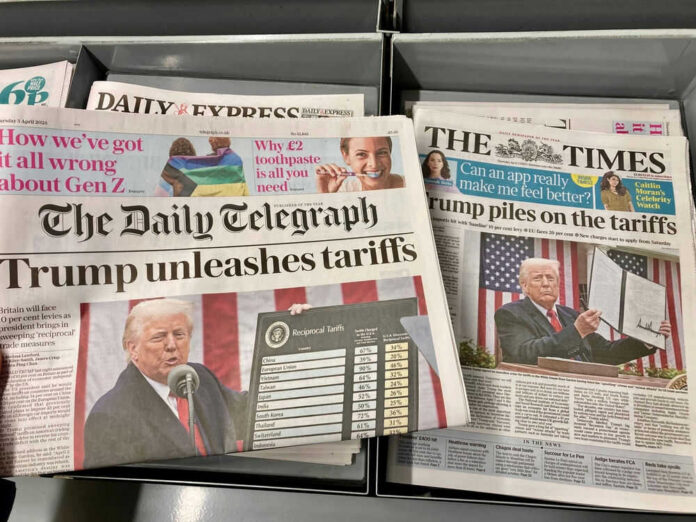
- The Supreme Court struck down Trump’s reciprocal tariffs on Feb. 20, 2026, rejecting the “national security emergency” rationale cited in reporting.
- Within days, Trump announced a new across-the-board global tariff—10% at first, then raised to 15%—and promoted it again in his Feb. 24 State of the Union.
- Multiple economists cited in the research argue tariffs function like a domestic tax that is largely passed through to U.S. consumers, not “paid by foreigners.”
- Research cited here points to 2025 economic softness, including a decline of 108,000 manufacturing jobs and total job creation falling to 181,000.
- Critics estimate households could face roughly $1,000 to $1,700 in annual added costs tied to tariff-driven price increases.
Court Check on Executive Power Sets the Stage
On Feb. 20, 2026, the U.S. Supreme Court struck down Trump’s reciprocal tariffs, concluding they did not meet the threshold of a national security emergency as described in the provided reporting. That ruling matters beyond trade policy: it signals real limits on executive branch workarounds when Congress hasn’t clearly authorized a sweeping economic program. Within a day, the administration pivoted to a new global tariff—10% initially, raised to 15%.
Trump then used the Feb. 24 State of the Union to argue tariffs are an economic lever that can deliver “tremendous growth” without inflationary fallout, according to the research summary. The coverage compiled for this piece frames that messaging as an attempt to hold the political high ground after the Court’s rebuke. The unresolved question for households is simple: whether the new tariff wave reduces costs and strengthens paychecks, or lands as another hidden charge.
What the “Four Myths” Debate Is Actually About
The core dispute is not whether the United States should defend its industries or negotiate better trade terms; it is whether broad tariffs reliably produce the results politicians promise. The research centers on four claims: tariffs save money and boost the economy; they reduce trade deficits blamed on foreign exploitation; they create manufacturing jobs and a boom; and they are paid by foreigners rather than Americans. Critics in the provided sources say the data does not support those claims.
The most tangible point is pass-through. Research referenced here says American businesses and consumers absorb nearly the full cost of tariffs, with one cited study pointing to near-complete pass-through to U.S. buyers. If that holds, tariffs behave like a nationwide consumption tax layered onto imported inputs and finished goods. For a conservative, limited-government audience, that mechanism matters because it shifts power and money upward—toward Washington revenue—while families quietly shoulder higher prices.
Trade Deficits: The Uncomfortable Math Behind the Talking Points
Several sources summarized in the research argue the trade deficit is better explained by domestic spending patterns than by foreign “cheating” alone. One cited framework describes the trade deficit as matching the gap between U.S. spending and GDP, with the 2025 trade deficit cited at $0.921 trillion. That identity doesn’t make bad trade deals imaginary, but it does mean tariffs by themselves may not “fix” the deficit if federal borrowing, consumer demand, and overall spending remain elevated.
That’s where the politics and the economics collide. Tariffs can raise government revenue—research here cites about $200 billion collected—yet higher revenue is not the same thing as stronger household finances. If Washington collects more while the price level embeds the tariff into everyday goods, the public experiences it like inflation even when official inflation prints cool. Some reporting also contrasts official inflation with alternative trackers, suggesting the cost pressure can be hard to see in top-line numbers.
Jobs and Growth Claims Run Into 2025’s Weak Results
Supporters sell tariffs as a tool to “reshore” production and create factory jobs. The research provided, however, points to 2025 outcomes moving the other direction: manufacturing jobs declined by 108,000, total jobs created fell to 181,000 after 2.2 million in 2024, and GDP growth slowed to about 2.2%. Those figures do not prove tariffs caused every negative result, but they do challenge the certainty of a guaranteed “boom” narrative.
Economists quoted in the sources argue tariffs can also scramble supply chains and raise input costs for U.S. producers, which can discourage hiring and investment. Even if certain protected firms benefit, the broader economy can feel the drag through higher component prices and consumer pullback. For households already frustrated by years of inflation and overspending, the practical concern is whether Washington is repeating the same mistake: promising relief while policies quietly raise living costs.
What to Watch Next as the 15% Tariff Takes Hold
Several unknowns remain, and the research acknowledges debate over timing and how quickly costs show up in retail pricing. Some costs may appear immediately in new orders; others can lag as inventories clear. But the cited estimate that tariffs could raise annual family costs by roughly $1,000 to $1,700 is the kind of kitchen-table number voters will test against reality fast. If those costs materialize, pressure will build for either exemptions, rollbacks, or a different strategy.
The 4 Economic Myths Powering Trump's New Tariff Push
American businesses and consumers absorbed nearly 90 percent of the 2025 tariffs' economic burden, the Federal Reserve Bank of New York found.
By @veroderugy https://t.co/x6B7OIZGC5
— Ephie Bernstein (@EphieBernstein) February 26, 2026
Politically, the Court’s decision adds another layer: when major economic policies are built on emergency rationales, they can be reversed as soon as judges reject the legal foundation. That instability is not “America First”; it is whiplash for businesses and families trying to plan. If the administration wants durable wins, the most constitutionally stable route is straightforward lawmaking—clear authority from Congress, transparent costs, and measurable goals that don’t depend on myths to sell them.
Sources:
https://www.democracynow.org/2026/2/25/joseph_stiglitz_sotu
https://thefulcrum.us/economy/tariffs-and-american-households
https://www.aol.com/articles/4-tariff-myths-trump-white-181553537.html
Copyright 2026, LibertySociety.com