
(LibertySociety.com) – North Korea’s biggest danger right now isn’t just the bomb—it’s the “fog of war” that could turn a misread signal into a nuclear crisis before diplomacy even has a chance to work.
Quick Take
- North Korea has hardened its nuclear posture by declaring its nuclear status “irreversible” and endorsing pre-emptive use in its legal framework.
- Weapons tests, hostile rhetoric, and large-scale U.S.–South Korea exercises create a high-risk environment for miscalculation and rapid escalation.
- Estimates of North Korea’s nuclear stockpile remain uncertain, ranging from a handful of weapons to several dozen.
- Russia and China continue to block meaningful UN Security Council pressure, weakening enforcement and deterrence tools.
Why the “Fog of War” Problem Is Getting Worse
North Korea’s nuclear risk is increasingly tied to confusion, speed, and broken communication channels. The current environment features repeated missile activity, threats from Kim Jong Un, and a stated doctrine that allows nuclear use under broader conditions than in past decades. When both sides are conducting highly visible military moves, leaders may assume the worst about the other’s intent, raising the chance that a routine drill or test is misread as preparation for attack.
North Korea has also spent years reducing the diplomatic “off-ramps” that used to slow crises down. Reports note the regime moved to prohibit denuclearization talks through constitutional and legal changes, effectively signaling that bargaining away the program is no longer on the table. With fewer direct channels and fewer shared expectations, a fast-moving incident—at sea, near the DMZ, or during a missile test—can become a political trap where leaders feel forced to escalate rather than de-escalate.
North Korea’s Capabilities: Real Progress, Real Uncertainty
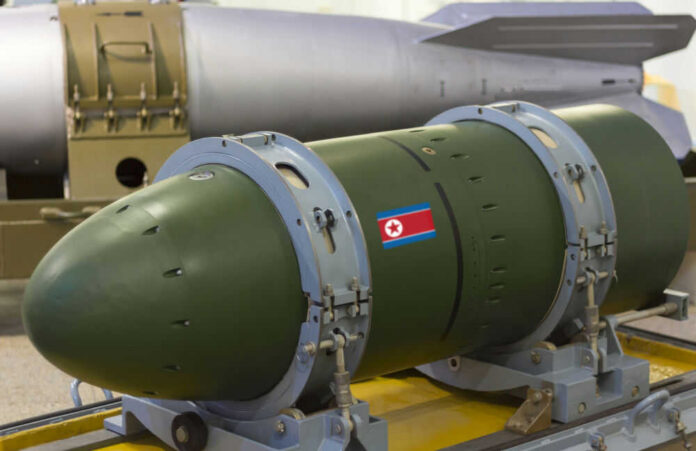
Available assessments point to a nuclear force that is both dangerous and hard to measure precisely. U.S. intelligence estimates described in public reporting suggest North Korea has enough plutonium for at least several nuclear weapons, with higher-end estimates far larger. What matters for deterrence is not just the number, but survivability and delivery options. North Korea’s missile forces can already threaten South Korea and Japan, and its longer-range systems increase pressure on U.S. planning.
North Korea’s pursuit of sea-based nuclear delivery is a major concern because it could strengthen a second-strike capability. Research tracking developments on the peninsula has highlighted work tied to ballistic-missile submarine aspirations, including claims about nuclear-powered submarines. Even if timelines are unclear, the direction is consistent: a regime seeking more ways to hide, move, and preserve nuclear forces under threat. That trajectory increases crisis instability because it compresses decision time for everyone involved.
U.S.–South Korea Deterrence Meets High-Stakes Signaling
U.S. and South Korean officials have responded to North Korea’s advances by emphasizing readiness and joint capabilities, including larger military exercises and deployments tied to nuclear-capable assets. These measures aim to deter aggression and reassure Seoul and Tokyo. The risk is that the same actions also add more “signals” for Pyongyang to interpret—sometimes incorrectly—especially during periods of heightened rhetoric and weapons testing. In a fog-of-war scenario, signaling can look like provocation.
Official U.S. strategy documents continue to describe North Korea as an increasingly capable nuclear threat, while also noting the North’s conventional danger to South Korea even with aging systems. That combination—nuclear danger on top of a large conventional force—creates layered escalation pathways. A conventional clash does not stay conventional automatically, particularly when one side has written pre-emptive nuclear use into its doctrine and sees nuclear weapons as central to regime survival.
Great-Power Gridlock Leaves Fewer Guardrails
International enforcement has weakened as major powers split over how to handle proliferators. Analysis cited in the research argues that divisions among great powers, including Russia and China’s behavior at the UN Security Council, have reduced accountability and blunted sanctions pressure. In practical terms, that means fewer credible, unified consequences to shape North Korean decisions and fewer diplomatic mechanisms that reliably pull crises back from the brink when tensions spike.
North Korea Has A Fog of Nuclear War Problem
(By @Robert_E_Kelly)https://t.co/uXYCXnBdbq— Harry J. Kazianis (@GrecianFormula) February 25, 2026
For American voters who watched years of global instability deepen while Washington chased ideological distractions at home, the lesson is straightforward: deterrence has to be clear, credible, and backed by strength. The research also notes uncertainty—especially the exact size of North Korea’s arsenal and the timeline for more survivable forces. That uncertainty is exactly why miscalculation is so dangerous. When adversaries guess, they sometimes guess wrong, and nuclear crises punish mistakes.
Sources:
Risk of Nuclear Proliferation in 2026
Nuclear tensions rise on Korean peninsula
2026 National Defense Strategy
Korean Peninsula Update: February 17, 2026
2026 National Defense Strategy Numbers: Radical Changes, Moderate Changes, and Some
Copyright 2026, LibertySociety.com