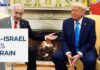

Israel’s decision to bomb Hezbollah strongholds in Beirut just days after a U.S.-backed ceasefire deal shows how fragile “peace on paper” is when terror groups keep launching rockets at a close American ally.[1][5]
Story Snapshot
- Israel struck Hezbollah-linked targets in Beirut’s southern suburbs despite a recently agreed ceasefire framework backed by Washington.[1][3][5]
- Jerusalem says the strikes responded to renewed Hezbollah rocket and drone attacks on northern Israel and its soldiers in southern Lebanon.[1][5]
- The targeted Dahiyeh district is both a major Hezbollah stronghold and a densely populated civilian area, heightening concern over civilian casualties.[4][5]
- The episode exposes the limits of diplomacy with Iran-backed militias and raises questions about how far the United States can really restrain them.[3][5][6]
Israeli Strikes Test a Fragile Ceasefire Deal
Israeli warplanes hit Beirut’s southern suburb of Dahiyeh, a core Hezbollah stronghold, even though Israel and Lebanon had only just agreed to implement a ceasefire after talks in Washington supported by the United States.[1][3][5] Lebanese media reported missiles striking apartments near a gas station junction, while Israel’s military said it carried out a “series of airstrikes” in the area following fire from Hezbollah into Israeli territory, including rockets and other projectiles aimed at northern Israeli cities.[1][5]
The ceasefire understanding reportedly hinged on Hezbollah halting attacks on Israel in exchange for Israel refraining from escalating operations in Beirut itself, a key condition relayed by U.S. mediators.[5][6] Within days, Hezbollah launched more rockets and drones, and Israel responded with strikes inside the capital’s southern belt, demonstrating how fast such arrangements collapse when one side keeps probing for advantage.[5][6] The strikes now raise serious doubts about whether any deal that leaves Hezbollah armed in civilian areas can be stable.
Hezbollah’s Role and Israel’s Security Calculus
Reports from Beirut and international broadcasters describe Dahiyeh as a traditional Hezbollah bastion where the group embeds command centers, underground infrastructure, and drone facilities directly in dense neighborhoods that also house hundreds of thousands of civilians.[3][4][5] Israeli officials say recent operations targeted underground drone production and other military sites tied to attacks on Israeli troops and communities, claiming they are hitting combat infrastructure rather than civilians.[4][5] From Israel’s perspective, allowing such facilities to operate freely near its border invites more rocket fire and cross-border raids.
Israel’s prime minister and defense minister issued a joint statement ordering the army to strike targets in Beirut’s southern suburbs after “repeated violations” of the ceasefire by Hezbollah and attacks on Israeli cities and citizens.[5] The Israeli military also reported intercepting rockets and a hostile aerial object launched from Lebanon, underscoring that the threat is not theoretical but ongoing.[1][5] For a small country where border communities have already endured years of rocket alarms, leaders argue that deterrence—making clear Hezbollah will pay a price even in its home turf—is essential to prevent a larger war down the road.[1][3][5]
Civilian Risk, Media Narratives, and U.S. Diplomacy Limits
Lebanon’s National News Agency reported at least two dead and eleven injured in one of the Israeli strikes on Beirut’s southern suburbs, with rescue operations continuing through damaged residential blocks.[1] Television footage described multiple buildings hit and residents fleeing Dahiyeh in heavy traffic after advance Israeli warnings to evacuate, showing the human pressure cooker created when militants operate among civilians.[4][5] International outlets emphasized that the same area is both a Hezbollah power base and a home for ordinary families, giving ammunition to critics who see the strikes as disproportionate or indiscriminate.[3][4]
Coverage of these strikes also highlights a familiar information pattern: Israel controls the initial operational narrative, stressing precision and military necessity, while Lebanese authorities and activists circulate casualty images to frame the attack as aggression or a ceasefire breach.[3][4] U.S.-brokered understandings, including President Trump’s efforts to “dial back” fighting between Israel and Hezbollah, remain vulnerable when Iran-backed militias test red lines and exploit civilian shields.[5][6] For American conservatives, the lesson is that paper deals with terror proxies cannot substitute for Israel’s right to act in self-defense, even when that collides with diplomatic timelines or elite commentary.[3][5][6]
Sources:
[1] Web – Israel Strikes Beirut’s Southern Suburbs Days After US-Supported …
[3] YouTube – Residents flee Beirut’s southern suburbs after Israel orders strikes
[4] YouTube – Israeli air strikes hit Beirut: Lebanon’s southern suburb of Dahieh …
[5] YouTube – Israeli strikes hit Beirut’s southern suburbs amid new evacuation …
[6] YouTube – Israel launches new strikes on Beirut: Military says it is …
© libertysociety.com 2026. All rights reserved.