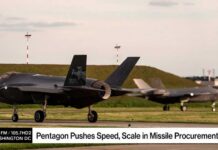
America’s most expensive fighter jet, the F-35 Lightning II, sits grounded more than half the time despite taxpayers pouring over $12 billion annually into keeping these planes flying—a failure that threatens our military readiness and exposes years of Pentagon mismanagement.
Story Snapshot
- F-35A mission capable rate plunged to just 51.9% in 2023, far below the Air Force’s 80% minimum target
- Six consecutive years of readiness failures across all F-35 variants despite massive spending increases
- Annual sustainment costs skyrocketed 34% to $6.6 million per aircraft while performance worsened
- GAO recommends Pentagon reconsider production schedules and contractor incentives amid chronic underperformance
Six-Year Pattern of Failure Exposed
The Government Accountability Office released a damning report in October 2024 documenting systematic failures across the F-35 program spanning fiscal years 2018 through 2023. Not a single F-35 variant—the Air Force’s F-35A, the Navy’s F-35C, or the Marine Corps’ F-35B—met desired mission-capable rates during this entire period. The F-35A’s mission capable rate collapsed from a peak of 71.4% in 2020 to a dismal 51.9% by 2023, meaning only half of these advanced fighters are actually available for missions at any given time. This catastrophic decline occurred even as the Air Force added approximately 40 new jets annually to the fleet.
F-35 mission capability rates remain far below targets, GAO Says https://t.co/nTB9tLyzZv
— Inside Defense (@insidedefense) March 5, 2026
Spare Parts Crisis Cripples Operations
The Air Force attributes the readiness collapse primarily to chronic spare parts shortages and repair materials deficiencies. Lt. Gen. Michael Schmidt, head of the F-35 Joint Program Office, acknowledged the crisis publicly: “I am not satisfied with our readiness today—and our team is doing everything in its power to drive availability to levels our users expect.” Yet despite these admissions and over $12 billion in annual sustainment spending, the situation continues deteriorating. The Pentagon currently operates approximately 630 F-35s with plans to purchase 1,800 more through 2032, raising serious questions about throwing good money after bad on a platform that spends nearly half its time grounded.
Costs Spiral While Performance Tanks
The financial burden on taxpayers continues mounting with no accountability in sight. Between June 2023 and 2024, the Air Force increased projected annual operating and sustainment costs per aircraft from $4.1 million to $6.6 million—a staggering 34% jump in barely a year. Total program costs reached an estimated $1.1 trillion as of 2018, making the F-35 one of the Pentagon’s largest acquisition programs ever. Meanwhile, the Air Force quietly extended the F-35’s planned operational life by 12 years while simultaneously reducing expected annual flight hours from 230 to just 187. These moves telegraph low confidence in the platform while locking taxpayers into decades more of escalating costs for underperforming aircraft.
Modernization Behind Schedule and Over Budget
The problems extend beyond current readiness failures to future capabilities. The F-35’s Block 4 modernization effort—designed to enhance targeting, navigation, communications, and electronic warfare systems—is now $6 billion over budget and won’t complete until 2031, five years past its original deadline. Defense analysts note this pattern reflects fundamental design and supply chain issues rather than temporary setbacks. Critics like defense analyst Mandy Smithberger argue bluntly: “It’s time for the Pentagon to cut its losses and phase out the program now, before we waste billions of additional taxpayer dollars on a flawed plane that spends almost half its time in the hangar getting repaired.” The GAO recommended the Pentagon reconsider production schedules and contractor incentive structures given persistent readiness failures.
Broader Military Readiness Concerns
The F-35 crisis isn’t isolated—it represents systemic failures plaguing America’s tactical aviation fleet. The GAO found multiple aircraft types failed to meet mission capable rates for six consecutive years, including the F-22 Raptor, EA-18G Growler, F/A-18 Hornets, AV-8B Harrier, and F-15E Strike Eagle. This industry-wide sustainment collapse undermines national security at a time when peer competitors like China rapidly modernize their forces. Pilots and maintenance crews face reduced training opportunities, allied nations operating F-35s confront similar readiness challenges, and American taxpayers shoulder ever-growing costs for diminishing military capability. The Air Force abandoned its longstanding 75-80% mission capable goal rate for most aircraft, instead establishing lower unit-specific targets that effectively move the goalposts downward rather than fixing underlying problems.
Sources:
Air & Space Forces Magazine – World Air Forces Report
National Guard Association – GAO: Military Continues to Struggle with F-35 Readiness
Congressional Budget Office – F-35 Joint Strike Fighter Program Analysis
Responsible Statecraft – F-35 GAO Report Analysis
U.S. Naval Institute News – GAO Report on the F-35 Joint Strike Fighter